It’s Not (Just) About the Printer! What Our 100th Single-Pass Inkjet System Really Taught Us
By Ken Stack, Executive Chairman, Engineered Printing Solutions (EPS)
At FuturePrint Industrial Print in Munich, we marked a milestone that took EPS four decades to reach: our 100th single-pass inkjet production system printing direct-to-object in live manufacturing. Add that to more than 300 multi-pass DTO inkjet systems and over 2,000 pad printers, and the number tops 2,400 installations worldwide. The congratulations were nice. But what I kept thinking about was everything we had to learn, and unlearn, to get here.
The headline isn’t “100 printers.” It’s “100 production systems.” That distinction between a print engine and a complete, end-to-end automated decoration solution, is where the real story of industrial inkjet lives. It’s also where too much of our industry still gets it wrong.
The Printer Was Never the Product. The Manufacturing Production System Is
For years, our industry talked about printheads, resolution, and ink chemistry as if a printer sitting on the factory floor could deliver ROI by itself. It can’t. The print step is only part of a manufacturing process that must also load and orient parts reliably, prepare surfaces for adhesion, inspect quality inline and offload finished goods without bottlenecks. When any one of those links is manual or inconsistent, the economics degrade fast. Our early digital projects taught us this the hard way: a great print engine inside a weak workflow still produces a weak business case.
Inkjet Technology Is Enabling the DTO Production Market
Pad, screen, and offset printing are extraordinary technologies. For long, stable runs they remain incredibly efficient. EPS built its first two thousand systems on analog for good reason. But manufacturers now manage proliferating SKUs, shorter runs, regional and seasonal variants, and growing demands for variable data—serialization, traceability, and regulatory coding—at production speed. In that environment, the make-ready and tooling overhead of analog becomes a drag on agility, not a driver of throughput. Digital DTO didn’t win because analog got worse; it won because the market changed.
The Real ROI Is Labor Automation
Eliminating plates and tooling costs matters. Our white paper, “The Shift in Direct-to-Object Printing,” lays out the break-even economics in detail and the math is compelling. A seven-color pad printing job carries roughly $500 in setup costs per run. A three-color job runs about $300. Digital’s cost-per-part is essentially flat regardless of run length. For runs under 5,000 to 7,000 units, digital wins on pure tooling economics alone.
But that’s small potatoes. The transformation shows up on the labor line when you automate the entire cell—feeding, pretreatment, single-pass print, inline vision, and offload. Consider a real deployment in hard-hat decoration from one of our customers. A typical three logo job averaged only 20 units. Analog required nine plates, nine ink mixes, and nearly five hours of labor. After moving to a fully automated single-pass UV inkjet cell, labor dropped by 81%, from 289 minutes to under 55 minutes, delivering about $285 in labor savings per job. At six jobs per day, annual savings topped $400,000 with payback in under 18 months. That is a labor automation and production efficiency story, not just a tooling story.
Engineering Printing for Adhesion, Color, and Consistency on 3D Parts
Printing onto three-dimensional objects is not paper. UV-cured inks rely on mechanical adhesion, which depends on the surface energy of each substrate. If pretreatment, flame, corona, plasma, or pyrosil is not validated for the exact material, parts can pass day-one inspection and fail in the field. More digital DTO projects have been derailed by adhesion than by anything related to “print quality.” Add the complexity of color management across polypropylene, glass, aluminum, and ABS, and it becomes clear why application know-how, pretreatment recipes, dot gain control on curves, geometry-aware fixturing and motion, is the real moat. These are lessons earned across deployments, not components you can buy off the shelf.
Direct-to-object approaches also remove labels and secondary decoration steps, cutting waste, simplifying supply chains, and enabling inline decoration within manufacturing, a sustainability and efficiency win many factories now prioritize.
What DTO Means for Manufacturers in North America, Europe, APAC and Globally
Across the U.S., the operators who could set up complex multicolor analog jobs by feel are retiring, while the incoming workforce expects software-driven, computer-like equipment. The fastest path to resiliency is a single-pass, automated decoration cell that runs with fewer hands and less variability shift-to-shift. When inline pretreatment, print, and vision inspection are engineered together, you stabilize quality, compress training time, and make ROI less dependent on employee knowledge, exactly what North American plants need as they scale personalization, traceability, and shorter runs.
In Europe, brands manage a high mix of regional languages, compliance marks, and seasonal SKUs. Direct-to-object printing removes labels and secondary steps, decreasing material waste while enabling just-in-time decoration inline with assembly. Our 100th single-pass milestone, announced in Munich, underscored a broader EU trend: digital DTO earns its keep when it’s delivered as a complete production system with validated pretreatment, geometry-aware handling, and closed-loop inspection, not as a standalone print engine.
APAC manufacturers often prioritize scalability and replication across multiple sites. Standardized, application-specific automated decoration cells—where feeding, pretreatment, print, and QA are pre-engineered as one—allow factories to copy-paste capacity with predictable uptime and quality. The question isn’t “which printhead?” but “how many decorated parts per hour, how many operators per shift, and what’s my cost per part?” When those answers are guaranteed at the cell level, expansion becomes a planning exercise rather than a custom engineering project.
From Custom Printers to Standardized, Vertical‑Specific Production Cells
For decades, capital equipment was sold as a machine that showed up on a truck and got bolted to the floor. The customer figured out the rest. That model breaks down in digital DTO. The next generation will be delivered as integrated decoration cells configured for the substrates, throughput, and quality targets of a given vertical. From packaging (caps, closures, rigid containers) and medical to industrial components and promotional products, manufacturers can buy guaranteed decorative parts per hour at a known labor cost. In this model, the system integrator who owns automation, application knowledge, and service becomes more important than any individual component vendor.
What Next in DTO
Our first 100 single-pass systems at EPS taught us that application knowledge, pretreatment, geometry handling, vision, color on 3D parts is the differentiator, and automation is the ROI engine. The next 100 will be about repeatable, pre-validated cells that can drop into production with minimal commissioning, accelerate payback, and be scalable across sites. We are clear that manufacturers were never really buying printers. They were buying a known volume and quality of decorated parts per hour with as few people in the loop as possible. For us, the companies that deliver the full production solution, not just a printer, will own the next decade of this DTO production market.
Engineered Printing Solutions Exclusive North American Distribution Partnership with Comec Italia, Strengthens its Direct-to-Object Printing Portfolio
East Dorset, VT — Engineered Printing Solutions (EPS), a leading innovator in Direct-to-Object (DTO) industrial printing, has reaffirmed its exclusive distribution partnership with Comec Italia S.r.l., the Italy-based manufacturer of industrial pad printing systems, covering the United States and Canada.
The agreement formalizes EPS’s continued representation of Comec’s full pad printing portfolio in North America and reinforces the business’s position as a leading provider of both analog pad and digital DTO printing technologies. By supporting both process types, EPS is able to run detailed ROI models against a customer’s actual production volumes, substrate requirements, and long-term operating economics before recommending a solution.
As part of the reaffirmation, EPS is expanding its active representation of the Comec portfolio to include its full range of vertical market solutions—machines purpose-built for the specific marking, decoration, and traceability requirements of medical devices, automotive components, industrial parts, electronics, packaging, and consumer goods.
Founded in 1970 Comec Italia designs and manufactures its complete range of pad printing systems at its Italian headquarters and production facility in Cavaria, Italy. With its products available in more than 25 countries, the company is known for its precision-engineered printing systems designed for continuous industrial use. From its EAZY compact benchtop machines that reduce ink consumption by 50 percent to its automated KE electronic series engineered for speed and repeatability, the exclusive partnership ensures Comec’s full pad printing portfolio is available for North American clients.
Manuele Baggini, Owner of Comec Italia S.r.l., said, “EPS has represented Comec in North America for many years and understands both our equipment and the industrial environments in which it operates. We are pleased to reaffirm this exclusive partnership and continue supporting manufacturers across the United States and Canada.”
EPS has deployed more than 2,400 printing systems across North America with 2000 analog and over 400 digital inkjet systems meeting clients’ DTO printing needs. Over four decades, the company has developed application expertise across substrate pretreatment, ink chemistry, adhesion testing, color management, process validation, and automation integration. That experience enables EPS to support customers across medical device manufacturing, automotive components, industrial parts, electronics, packaging, and sporting goods.
Pad printing continues to serve applications requiring high-volume, multi-color decoration on irregular surfaces with proven process stability. Digital inkjet technologies provide advantages where variable data, short runs, SKU proliferation, and automation-ready workflows are required. By offering both technologies at production scale, EPS can compare process performance and long-term cost structures under real operating conditions.
Ken Stack, Executive Chairman of Engineered Printing Solutions, said, “Many suppliers specialize in a single print process. EPS has taken a different approach by maintaining expertise in both analog pad printing and digital inkjet. Our continued partnership with Comec Italia allows us to support customers whose applications remain well suited to pad printing, while also serving those transitioning toward digital production. The decision is driven by the application and production economics.”
Through its agreement, EPS will continue to provide installation, operator training, consumables supply, and field service support for Comec systems throughout North America. The company will also integrate pad printing platforms into broader automation and production line solutions where required.
The reaffirmed partnership reflects ongoing demand for industrial pad printing alongside digital decoration technologies, particularly in production environments requiring repeatability, durability, and validated marking processes.
How Can I Print Direct-to-objects? Printing on Shapes – Expanding What’s Possible in Direct-to-Object Manufacturing
Engineered Printing Solutions
February 26, 2026
During an interview with Mary Schilling from WhatTheyThink’s Cool Tools at Printing United, one theme surfaced again and again: manufacturers are increasingly focused on direct-to-object printing for three-dimensional products. While much of the print industry still thinks in terms of flat substrates, labels, and paper-based workflows, real-world manufacturing depends on decorating complex shapes, curved surfaces, and dimensional parts.
At Engineered Printing Solutions, this shift is something we see every day. The future of industrial printing lies in applying graphics, branding, and functional markings directly onto the product itself rather than onto a label applied later.
What is Direct-to-Object printing?
Direct-to-object printing removes labels, stickers, and secondary decoration steps from the manufacturing process. Instead of printing onto paper or film and applying it afterward, graphics are printed directly onto the part. This approach supports a wide range of materials including soft and rigid plastics, glass, metals, ceramics, and wood.
By eliminating labels, manufacturers reduce waste, simplify supply chains, and shorten production cycles. It also allows decoration to happen inline with manufacturing rather than as a separate downstream process.
How to Print on Three-Dimensional Products
Printing directly onto three-dimensional products introduces challenges that flat printing processes were never designed to solve. Most parts are not created with printing in mind. Curves, recesses, surface textures, and inconsistent geometry all affect how ink behaves once it is applied.
Addressing these challenges requires more than a print engine. It requires engineering, automation, and precise control over how parts are fixtured, oriented, and presented to the printing process. In many cases, solving the print challenge starts with solving the part-handling challenge first.
What is the difference between Pad Printing and Inkjet for Complex Shapes?
Historically, pad printing has played an important role in decorating complex geometry. As an on-contact process, pad printing can reach into crevices and conform to uneven surfaces that would be difficult for other technologies. That capability still makes pad printing relevant for certain applications today.
Inkjet approaches the same problem differently. As an off-contact process, inkjet jets droplets through the air rather than physically contacting the part. This allows products to remain in motion and enables much higher throughput. It also supports digital image control, faster changeovers, and more complex graphics than analog processes typically allow.
The challenge with inkjet is consistency. Precise drop placement and reliable adhesion must be maintained across varying shapes and materials. When those conditions are met, inkjet delivers significant advantages in speed, flexibility, and scalability.
Why is Surface Energy and Pretreatment important in direct-to-object printing?
Surface compatibility is often the most significant obstacle in direct-to-object printing. Even materials that appear identical can behave very differently when ink is applied. Surface energy determines whether ink spreads evenly or beads up and fails.
That is why pretreatment is frequently required in industrial inkjet workflows. Techniques such as flame, plasma, corona, and pyrosil treatment modify the surface to promote adhesion and image quality. Each application is evaluated individually, with inks and pretreatments tested together to determine the most reliable solution for long-term durability.
What is the role of Robotics and Automation in Industrial Inkjet Printing?
One of the most notable developments discussed at Printing United was the growing role of robotics in direct-to-object printing. Automation is no longer limited to loading and unloading parts. Robotic inkjet end-of-arm tooling allows the print system itself to move around the part rather than forcing the part to move through a fixed machine envelope.
This approach significantly expands the range of products that can be printed digitally. Large injection-molded components such as waste containers, safety equipment housings, or industrial panels often cannot fit under traditional pad printers or fixed inkjet systems. With robotic motion, those same parts can now be decorated efficiently and consistently.
How does UV Inkjet drive Production Efficiencies in Direct-to-object printing?
UV inkjet plays a critical role in making these workflows production-ready. UV inks cure instantly using LED technology, allowing parts to move directly from printing to assembly or packaging. The cured ink provides strong adhesion and surface hardness, often without the need for post-coating except in demanding outdoor or environmental applications.
This immediacy supports higher line speeds and tighter integration with downstream manufacturing processes, making digital printing a practical option for production environments rather than just prototyping.
What is the future of Direct-to-object printing?
What we are seeing in direct-to-object printing today is a broader shift in how manufacturers think about decoration. Printing onto three-dimensional products is no longer a niche capability. It is becoming a core manufacturing process for companies looking to reduce complexity, improve efficiency, and design more flexible production lines.
As inkjet, automation, and robotics continue to converge, the boundaries of what can be printed directly onto a product will continue to expand. The conversation is no longer about whether digital can handle complex shapes. It is about how far manufacturers are willing to push it.
Find out more about EPS’s printing solutions here: Engineered Printing Solutions: Company Page Admin | LinkedIn
Engineered Printing Solutions Celebrates Milestone 100th Sale of Single-Pass Direct-to-Object Inkjet System
East Dorset, VT — Engineered Printing Solutions (EPS), a leading innovator in Direct-to-Object (DTO) industrial printing, today announced the sale of its 100th single-pass DTO inkjet production system, marking a major step in the manufacturing industry’s shift from analog decoration to high-speed digital production.
Founded in 1985 as a specialized pad-printing engineering company, EPS has grown into a global leader in industrial digital printing and automation. Today, the company has deployed more than 2,000 pad printers, 300 multipass DTO inkjet systems, and now 100 production-grade single-pass DTO machines, forming one of the most experienced installed bases in the DTO market. From developing the first tagless T-shirt system with Hanes to transforming the way caps and closures, hard hats, golf balls, and other complex shapes are printed, EPS has helped drive the analog-to-digital conversion across multiple industries.
The sale of the 100th system reflects wider market trends reshaping product decoration. Manufacturers today must support shorter batch sizes, long-tail SKUs, quicker changeovers, and on-demand customization—needs that traditional pad, screen, and offset printing cannot meet cost-effectively due to tooling costs, long setups, and skilled-labor reliance. Single-pass digital DTO eliminates plates, clichés, screens, and setup fees, enabling rapid artwork changes, variable data, and inline 2D code traceability without reducing production speed.
Rising labor costs and workforce shortages are also accelerating digital adoption. Single-pass UV inkjet reduces labor hours by up to 81% while aligning with automation-ready workflows, including robotic loading, pretreatment, inspection, and unloading. Because digital DTO is software-driven, brands can maintain consistent print quality across shifts while minimizing operator training and dependency.
EPS Executive Chairman Ken Stack described the milestone as a pivotal moment for the industry. “Reaching our 100th single-pass DTO system is more than a sales milestone—it marks a turning point in how manufacturers think about product decoration. Digital DTO has moved from early adoption to mainstream production, driven by the need for agility, automation, and measurable ROI. Our next 100 systems will help shape the future of manufacturing for brands that demand reliability, flexibility, and world-class engineering support.”
EPS’s experience across the first 100 single-pass systems has reinforced the importance of full production-cell engineering. Pretreatment, ink chemistry, color management, part transport, and automation all play major roles in digital success. EPS’s engineering, chemistry, and color-science teams work directly with customers to develop and validate application-specific workflows. The company emphasizes uptime, reliability, and 24/7 production readiness as core differentiators, noting that DTO machines operate inside continuous factory environments where “if the printer is down, the factory is down.”
EPS is celebrating its 100th single-pass sale in partnership with Kingston Aluminum Technology (KAT) of Canada. KAT’s patented Alumishape™ technology produces uniquely shaped aluminum bottles designed for high shelf impact and sustainability. EPS engineered a flexible single-pass system capable of printing before bottle forming, enabling the containers to be shaped after decoration without distorting the artwork. The system delivers 80 cans per minute, creating a new benchmark for post-formed aluminum packaging.
Ben Pilon, President of BPE Group, KAT’s parent company, highlighted EPS’s engineering collaboration. “Finding a print solution was a long process for us. With our new technology, we had been through a lot of testing, and it was proving to be a major challenge.”
“Working with EPS was a completely different process compared to other solutions. EPS provides quick response times, creativity, and the ability to problem solve. They worked with us to develop something new and I felt confident that together it would be a great solution. Our current printer has been working great, support has been very good and most importantly, our customers are happy.”
For more than 40 years, EPS has helped manufacturers streamline workflows, reduce labor dependency, expand SKU agility, and improve print economics across packaging, promotional, medical, industrial, and consumer goods. The company continues to invest heavily in R&D at its Vermont facility, advancing new methods of digital decoration and turnkey automation.
Moving with the times – the Future of Industrial Inkjet
By Ken Stack, Executive Chairman, Engineered Printing Solutions
Industrial inkjet has matured quickly, and nowhere was that more evident than walking the floor and talking to customers at Printing United 2025. What stood out this year wasn’t faster, wider equipment, it was the unmistakable shift toward production-grade direct-to-object (DTO) inkjet and the automation required to support it. The industry is clearly moving into its next phase, where the future belongs to manufacturers that pair high-performance single-pass printing with high-performance automated workflows.
For years, DTO was synonymous with scanning inkjet systems. They are flexible, relatively easy to operate, and have been the default solution for short-run and mid-volume customization. But for customers scanning systems come with inherent limitations: each machine typically requires a dedicated operator, and while they excel at agility, they do not deliver true production throughput. As brands introduce more SKUs, seasonal variations and on-demand customization, many customers now find themselves running fleets of slower scanning systems to keep up—adding labor, compounding complexity and increasing the risk of bottlenecks.
That dynamic is changing fast. Single-pass inkjet has reached a new level of reliability, consistency and throw-distance performance, making it practical for high-volume DTO manufacturing. Customers who once managed multiple scanning units are now asking a new question: How do we consolidate volume, reduce labor requirements, and drive real production efficiencies? Single-pass provides the answer. It lets manufacturers migrate high-volume SKUs onto one high-throughput line capable of decorating thousands of objects per hour.
But that shift also exposes a new reality. The bottleneck in DTO is no longer the print engine, it’s everything around it. A single-pass system can print faster than any human can load, unload, orient or transfer parts. While scanning systems give operators time to manually handle parts between cycles, single-pass removes that margin entirely. Human operators simply cannot feed parts fast enough or consistently enough to keep pace with modern digital throughput. To unlock the full economic advantage of production DTO, automation becomes essential.
And that is exactly what I noticed throughout the show floor this year. More manufacturers, integrators and print providers were asking the same question: How do we design end-to-end workflows that can keep up with the printer? Conveyance systems, robotic handling, intelligent orientation, automated inspection and adaptive fixturing are rapidly becoming the critical enablers of production inkjet. The printhead technology has already made its leap, now the rest of the manufacturing environment must evolve with it.
At EPS, we’re already seeing this firsthand. Our introduction of motion-controlled and robotic printing concepts generated strong interest not because of the robot itself, but because it signals where the industry is heading. As single-pass DTO accelerates, flexible automation will be the key to bringing digital print to more shapes, more materials, and more production workflows. Ultimately, the promise of single-pass is not just speed, it’s the ability to deliver consistent, labor-efficient, high-volume output with minimal operator intervention.
Industrial inkjet is no longer just a tool for decoration; it is becoming a core manufacturing technology. The next wave of innovation will focus on integrating digital print seamlessly into production lines, reducing labor dependency and enabling manufacturers to scale without scaling headcount. And over the coming months, we’ll have more to share about new automation solutions designed specifically to keep pace with high-speed DTO—solutions that will help manufacturers fully realize the economic and operational advantages of single-pass inkjet.
To keep up to date with the latest trends and developments in Industrial Inkjet, follow us on LinkedIn
EPS and Tantec Partner to Deliver Innovative Integrated Single Pass Printing Solutions
East Dorset, VT – November 4th, 2025:
Leading direct-to-object solution provider EPS has joined forces with surface treatment specialists Tantec to provide customers with single pass digital print solutions that offer breakthrough adhesion, enhanced print quality, higher throughput and flawless production.
EPS, a Xaar company, known globally for its custom inkjet printers, provides single pass digital and pad printing solutions to manufacturing workflows worldwide. This expertise in high-speed printing now meets Tantec’s advanced plasma and corona surface treatment expertise to deliver a solution which combines robust adhesion with the speed and flexibility of single pass printing.
Customers in the automotive, medical devices, electronics, appliances and packaging sectors will benefit from the new partnership, which strengthens both companies’ positions in these industries where precision and quality are crucial, offering seamless integration and superior end-results.
Chris Ellis, President at EPS, commented: “Our production single pass UV inkjet platforms bring Tantec’s proven plasma and corona surface treatments into full-scale digital manufacturing, providing faster time-to-market and greater reliability in demanding applications where accuracy is vital.”
“What’s more, this partnership has enabled EPS to enhance its development lab with Tantec plasma equipment and provided Tantec with the opportunity to validate and demonstrate surface treatment in real-world single pass production environments, providing mutually beneficial platforms for further innovation.”
Jeff Gradus, Vice President at Tantec, added: “Working closely with EPS allows us to integrate our plasma and corona technologies into exciting new applications. Together, we can help customers achieve outstanding adhesion performance and printing quality, while streamlining their production processes.”
Tantec and EPS are already working together with several mutual customers, providing optimized system solutions and sharing insights to improve production workflows.
Looking ahead, Tantec and EPS are committed to further expanding their partnership. By sharing internal knowledge, capabilities, and development resources, both companies aim to drive innovation and offer customers the most advanced and efficient solutions on the market.
Why Partner with EPS
East Dorset, VT – October 2th, 2025:
WE LISTEN | WE UNDERSTAND | WE DESIGN | WE BUILD
Engineered Printing Solutions is a leader in designing, building, and servicing solutions for industrial printing applications for companies seeking to improve their products through more efficient processes.
Engineered Printing Solutions offers expertise in a wide variety of situations, across digital inkjet, pad printing, and fully automated printers. By focusing on improving your final product, Engineered Printing Solutions provides innovative, imaginative products that are sophisticated and dependable. We don’t force a technology choice on our customers – we work with you, as your print consultant, to choose between analog and digital.
We help clients find innovative ways to improve their workflow process and bottom line, for applications ranging from single-color to full-process artwork, industrial equipment to consumer goods, medical devices to automotive parts, and more.
EPS ensures that each customer can successfully print on the complete range of materials that led to its purchase. We take this responsibility very seriously and offer our customers access to many different forms of in-line surface pre-treatment with our printers. Surface pre-treatment, ink choice, color management and curing are critical to the print process for UV inkjet, and EPS optimizes both type and settings for our customers through our Precision Print program. EPS’s Precision Print Ink Adhesion / Jetting Optimization Program combines decades of experience on ink choice, pre-treatment and waveform optimization.
We are your one stop shop for equipment, consumables and support. Our passion and innovation help you drive efficiencies, reduce labor costs and elevate your brand while expanding your business.
Let’s have a conversation and see how we can help you reach your goals.
About EPS
EPS is a leading manufacturer of custom high-speed pad and single-pass UV inkjet direct-to-object printing lines for the packaging, industrial, automotive, promotional, and sporting goods markets. Based in East Dorset, Vermont, the team has over 40 years’ experience building custom machines and automations that combine print quality with labor and production efficiencies. As part of the Xaar Group, EPS leverages the latest inkjet technology to deliver highly customized product print systems worldwide.
To learn more, visit www.epsvt.com.
EPS Launches White Paper on How Single-Pass UV Inkjet Transforms Direct-to-Object ROI
East Dorset, VT – September 4th, 2025: Engineered Printing Solutions (EPS) has launched a new white paper, The Shift in Direct-to-Object Printing, showing how single-pass UV inkjet technology is redefining the economics of direct-to-object (DTO) decoration.
The report highlights how single-pass UV inkjet offers manufacturers and decorators faster ROI with near-zero setup costs, major labor efficiencies, agility, and sustainability benefits versus traditional analog methods such as pad, screen, and offset printing.
Unlike legacy techniques—which require plates, screens, clichés, and significant setup time—single-pass UV inkjet removes those expenses, enabling economical short runs, rapid design changes, and customized production from the very first unit.
With flat per-unit costs, EPS’s ROI analysis and case studies in the white paper demonstrate break-even volumes and more than $400K in annual savings in one client example. A new ROI calculator lets manufacturers enter their own production data to identify which SKUs should go digital and how print lines can be future-proofed.
Single-pass UV inkjet prints full-color, high-resolution graphics in one pass, supporting variable data, QR codes, and real-time artwork changes. Customers report labor savings of 80–90%; CNC-like repeatability and minimal operator training further enhance efficiency. UV-curable inks also eliminate VOC emissions and hazardous waste, creating a cleaner, safer, and more agile production process.
“Single-pass UV inkjet isn’t just a more flexible print technology, it’s a cost-model breakthrough,” said Kenneth Stack, Executive Chairman. “By removing setup costs, single-pass digital DTO lets manufacturers turn short runs and customization into profitable opportunities, not cost burdens.”
Ideal for packaging, consumer electronics, medical devices, and promotional products, single-pass digital DTO supports just-in-time production, seasonal promotions, and personalization—delivering speed, sustainability, and rapid ROI.
Download the full white paper
About EPS
EPS is a leading manufacturer of custom high-speed pad and single-pass UV inkjet direct-to-object printing lines for the packaging, industrial, automotive, promotional, and sporting goods markets. Based in East Dorset, Vermont, the team has over 40 years’ experience building custom machines and automations that combine print quality with labor and production efficiencies. As part of the Xaar Group, EPS leverages the latest inkjet technology to deliver highly customized product print systems worldwide.
To learn more, visit www.epsvt.com.
Contacts
EPS: Ken Stack — (800) 272-7764 — info@epsvt.com
Media: Nielsen McAllister — Simon Wildash / Hannah Woods / Alice Blackwell — +44 1332 293939 — eps@nmpr.co.uk
Megnajet’s Fluid Relationship Delivers for Engineered Printing Solutions
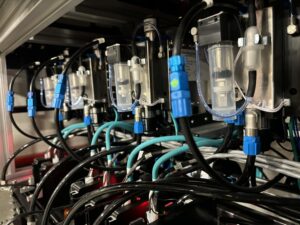
Megnajet CIMS II integrated into EPS XD R Hard Hat Printer
Kettering, 13th March 2024: The winning combination of high-quality, reliability and innovation has made Megnajet’s fluid management systems the continued choice for custom industrial inkjet systems manufacturer Engineered Printing Solutions (EPS).
The close, collaborative partnership between the two companies has seen a succession of Megnajet’s reliable and versatile fluid management systems used by EPS in the building of their bespoke high speed single pass inkjet machines.
Based in East Dorset, Vermont in the US, EPS has been manufacturing unique machines to print on a wide variety of products and goods. From single-colour to full-process artwork, industrial equipment to consumer goods, medical devices to automotive parts, EPS collaborates with its partners to build unique print solutions – and reliability and consistency are therefore key.
Initially the business built its own fluid management system, however as customer demands became more complex, it was clear that a dedicated resource was needed.
EPS chose to utilise Megnajet’s expertise in fluid management systems within its custom-built machine solutions. The ability to handle multiple fluids at high volume within a compact footprint has supported the growth of EPS’s high-speed, single-pass inkjet and direct-to-shape print solutions.
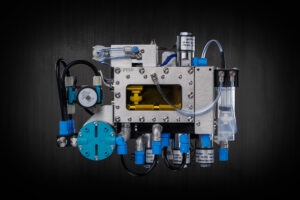
Full view of the Megnajet CIMS II
The business uses a variety of Megnajet products including the HV HFR and CIMS range. Alongside reliability, innovation is also key to the collaboration and Megnajet’s latest products including the Labjet and RackFit are proving of great interest.
Megnajet’s RackFit is a high-quality, compact fluid management system designed to be rack mounted for ease of integration and scalability. It’s ‘blade’ configuration allows customers to stack multiple units side-by-side to create the ultimate compact fluid management engine.
Ken Tyler, National Sales Manager, Strategic Accounts at EPS said: “We build custom, high-speed, printers that are driven by each client’s unique application and having a reliable fluid management system is crucial to every machine built.
“Megnajet’s products deliver the quality and consistency we need and the collaborative relationship we have had since the very start makes them ideal for use across the huge range of our partners’ print applications.”
The two companies take pride in their longstanding partnership and since becoming sister companies, as both are now part of the Xaar Group, have seen collaboration increase and success continue.
“Working in partnership has always been ingrained in the collaborative approach we have had,” said Adam Eaton, Engineering Manager at Megnajet.
“EPS has been instrumental to our growth and now as sister companies, the relationship has developed with a focus on innovation – ensuring we continue to deliver the fluid management systems that the latest inkjet print applications require.”
Demand for inkjet is increasing significantly in print applications, driven by new printhead and fluid developments. High viscosity is opening new avenues and taking inkjet beyond single colour and basic CMYK print applications.
“As inkjet becomes more advanced, it is taking over from traditional print techniques,” said Ken Tyler. “Our clients are wanting a wider colour gamut, metallics and neons alongside topographical print features as part of their custom solutions and fluid management systems are therefore even more critical in delivering the results required.
“As you put down more ink, consistency is even more important and with Megnajet’s systems integrated as part of our EPS print solutions we can deliver the quality and innovation that brand owners want to see.”

 About
About Contact Us
 (800) 272-7764